The Diagnosis
Why Jevons' paradox applies to human time. Why saving time doesn't create freedom but ever-higher expectations. The time famine of Perlow and Whillans: time scarcity is as real as economic scarcity.
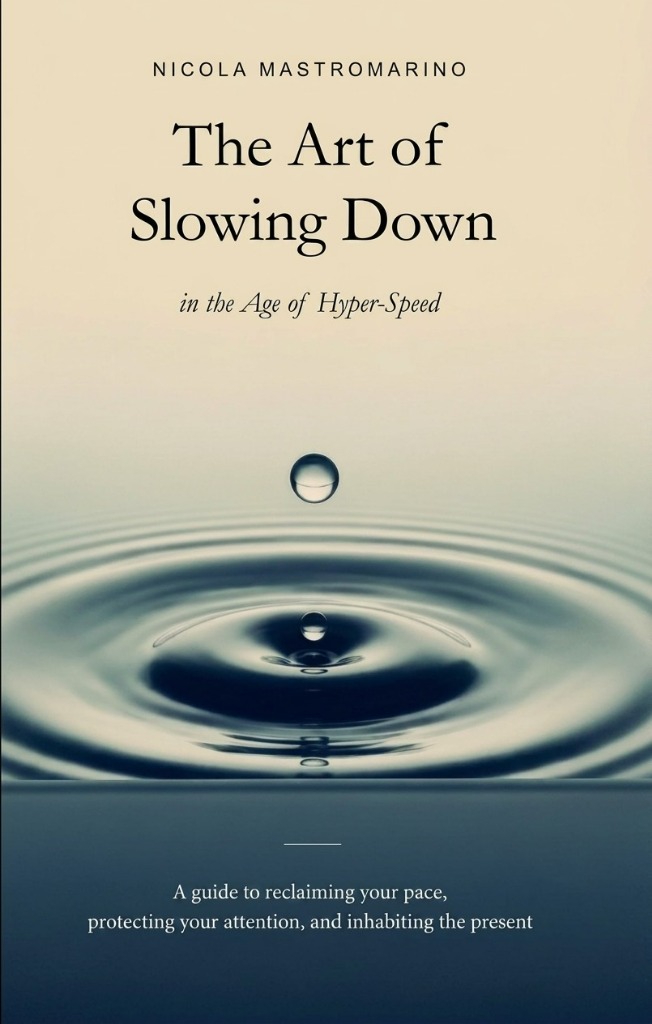
Non-Fiction · Personal Growth
in the Age of Hyper-Speed
A guide to reclaiming your pace, protecting your attention and inhabiting the present in a world that never stops.
Available on Amazon · eBook ($8.99) & Paperback ($15.99)
«It is not that we have a short time to live, but that we waste a lot of it.»
Seneca, On the Shortness of Life
The Book
It is 11:47 PM. The ceiling above you is the same one you have stared at for years, yet tonight you look at it as though it is the first time you have held still long enough to actually see it.
Your phone is still in your hand, screen off, but your thumb keeps moving anyway—out of habit—toward an app you did not even choose to open. You checked the list of things you did today. There were many. And yet you cannot name a single one that really counts.
This is not ordinary tiredness. Ordinary tiredness is cured by one night of sleep. This is something else: the feeling of having run all day while standing still.
If this scene is familiar to you, I want to tell you something before anything else: it is not your fault.
This essay is not a productivity manual disguised as a book on slowness. It is a journey that tackles with scientific and philosophical rigor the question that no self-help guru truly dares to ask: what if the problem isn't you, but speed itself?
What you will find
Why Jevons' paradox applies to human time. Why saving time doesn't create freedom but ever-higher expectations. The time famine of Perlow and Whillans: time scarcity is as real as economic scarcity.
What happens in the amygdala when urgency becomes chronic. How permanent cortisol degrades deep attention and sleep. The distinction between Kronos and Kairos to inhabit time in a radically different way.
Ten scientifically grounded protocols to defuse reactivity and regain control of your own pace. Each protocol is structured into Purpose, Action, and Key Question — applicable immediately.
The Approach
We often think time management is a willpower problem. It isn't. Working in the development of Artificial Intelligence systems, my daily life is focused on optimizing processes to make them as fast and efficient as possible.
I wrote this essay precisely in contrast: applying the same analytical and structured approach to the opposite need, that of slowing down and protecting our time.
The Toolkit
Each chapter of the book ends with a tested protocol. Not generic advice: precise tools with a stated purpose, a defined action, and a key question to anchor the change.
Available now
$8.99
Available immediately on all Kindle devices and the free Amazon app.
Buy on Kindle$15.99
6 x 9 format. Professional layout optimized for slow reading.
Buy on Amazon